Showing posts with label Systemnahes Programmieren. Show all posts

Friday, March 30, 2007

Gettin' started with C

So far the following description will describe a very fast way how to compile a c-application under windows. You just have to install the Borland C Compiler which you can find under the following link: Borland C Compiler By the way you will find a detailed german description under next link: German Description

After the registration at Borland you will be redirected to the download-page. Just get the the compiler-package and install it. Add the path of the install-directory to your env-vars and type 'bcc32' to the command line.

You then should be able to see the tool's version and the command line options. Write a simple c-application and then type the following to compile your application:

From C Programming

After your programm compiled successfully you should see some output like this:
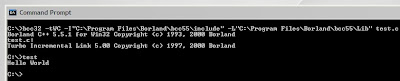
From C Programming

Hopefully this helps you to get started with C.
Cheers

Tuesday, March 13, 2007

SYSPROG | Block zum 1. Übungsbeispiel

This lesson was presentet by Raimund Kirner and the lesson's topic was "Block zum 1. Übungsbeispiel" and hence I thought the first exercise of this lecture would be described in detail but I was wrong.

Raimund Kirner explained some very basic features of the C programming language. E.g. example very simple c-commands were discussed (getopt, stderr, printf, fflush, ferror, fopen, fread, fwrite) and also simple i/o-operations were explained in detail.

Topics (german):
  • Argumentenbehandlung
  • Umgang mit Fehlern
  • I/O, Dateioperationen
  • Message Queues, Named Pipes
  • Signalbehandlung
The teacher's presentation style was very boring but I think that's quite normal for the presentation style at the Technical University of Vienna although I can't think of a more interesting way to present these kind of topics.

2-morrow (14th March) the first exercise will be announced and the students will be able to get their student-accounts during the official lab opening-times (Wedn. 10:00-13:00 hrs.) for this lecture.

For further information you must to check the official lab-hompage.

Cheers

Monday, December 04, 2006

Persistent vs. Transient

Im Rahmen der LVA 'Einführung in Semantic Web', musste man bei der ersten Übung eine Ontologie modellieren und eine Frage bezüglich der zu modellierenden Instanzen war folgende: "Ist eine Kommunikation zwischen zwei Personen mittels Applikation persistent?" Hierzu muss man jedoch wissen, was persistente Kommunikation eigentlich bedeutet. Tante Google meint:

Die persistente Kommunikation ermöglicht das Zwischenspeichern von Nachrichten im Kommunikationssystem, d.h. diese Nachrichten werden solange im Kommunikationssystem gespeichert, bis sie zum Empfänger übertragen werden können.

Entscheidend dabei ist jedoch, dass der Empfänger zum Zeitpunkt an dem der Sender die Nachricht abschickt, nicht aktiv sein muss. Genauso muss der Sender nicht aktiv sein, wenn der Empfänger die Nachricht entgegennimmt.

Bei der persistenten Kommunikation gehen daher keine Nachrichten verloren, diese Kommunikationsform bietet sozusagen eine Übertragungsgarantie.

Im Vergleich zur persistenten Kommunikation erlaubt die transiente Kommunikation eine Übertragung nur dann, wenn sowohl Sender als auch Empfänger zum Zeitpunkt der Nachrichtenübermittlung aktiv sind. D.h. es werden die Nachrichten nur solange im Kommunikationssystem zwischenspeichert, solange beide Prozesse aktiv sind.

Wieder etwas gelernt...!